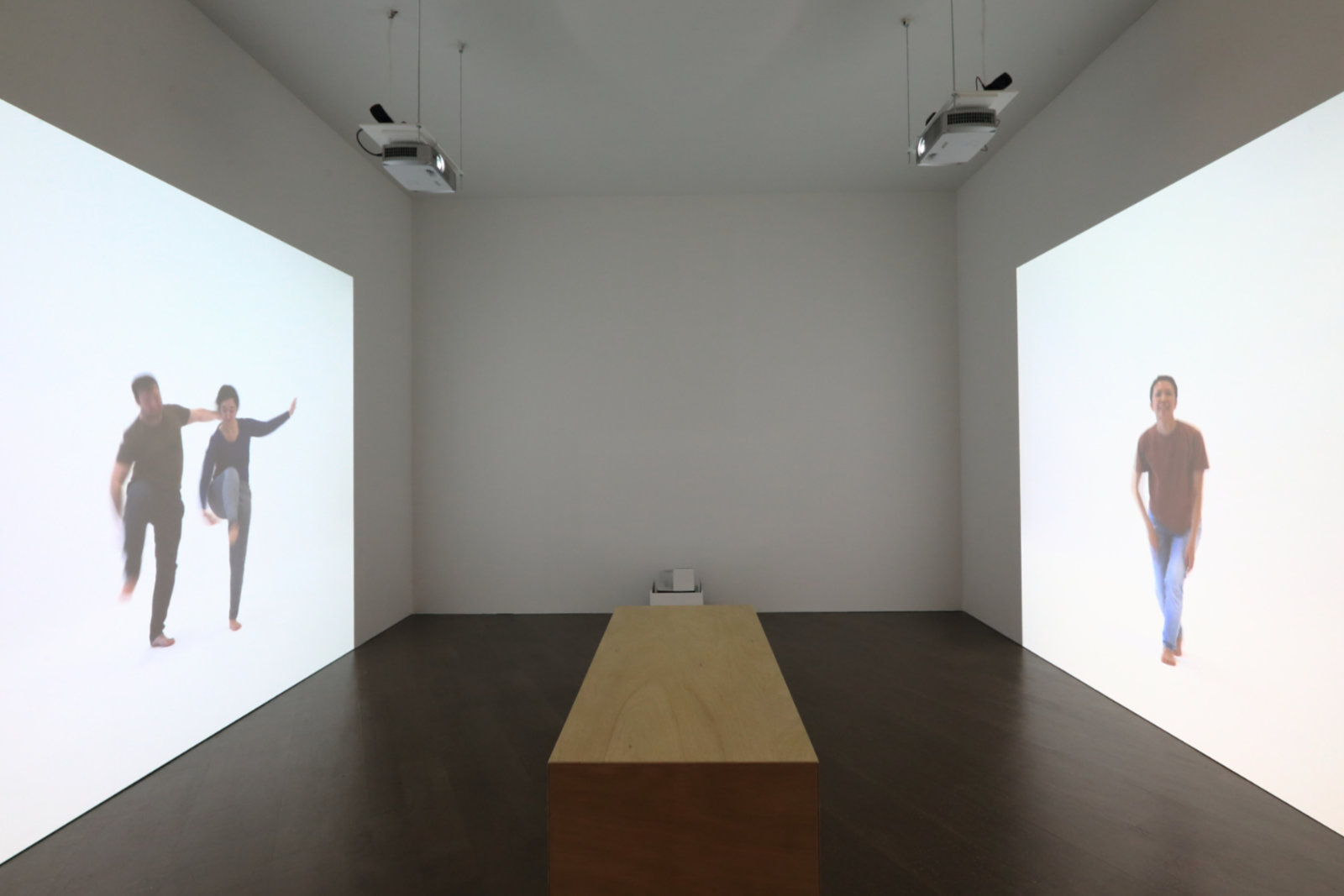
Cette œuvre explore la manière dont la mémoire d’un pays, inscrite dans le corps, peut être partagée et répétée avec autrui, tout en portant en elle le décalage engendré par la migration.
Dans les deux vidéos qui se font face, des interprètes se transmettent, comme au jeu du téléphone sans fil, une danse traditionnelle de la communauté des Coréens zainichi* du Japon, uniquement de mémoire. Dans la vidéo placée entre les deux, un enfant apprend à son parent à prononcer le français sans accent japonais. En répétant l’expérience de l’« échec » à parler correctement le français, l’enfant et le parent la transforment en jeu.
* Coréens zainichi : descendants de Coréens venus ou amenés au Japon pour des raisons diverses, principalement pendant la période coloniale, et qui continuent d’y résider aujourd’hui.
身体に刻まれたある国の記憶を、移動により生じたずれを内包しながら、どう他者と共有し繰り返すかを追った作品。向き合うふたつの映像では、在日コリアン・コミュニティの伝統舞踊を、ダンサーたちが自らの記憶のみを頼りにして伝言ゲームのように伝え合う様子が映される。その間にある映像では、子供が親にフランス語を日本語のアクセント無しで発音できるよう教える。フランス語を正しく話せないという「失敗」の経験を繰り返すことで、遊びへと転換させている。
This work explores how the memory of a country, inscribed in the body, can be shared and repeated with others, while carrying within it the gap created by migration.
In the two videos facing each other, dancers pass on a traditional dance of the Zainichi-Korean* community in Japan like a game of telephone, relying only on their own memories. In the video between them, a child teaches a parent to pronounce French without a Japanese accent. By repeating the experience of “failure” to speak French correctly, the child and parent turn it into play.
* Zainichi-Korean refers to descendants of Koreans who came to, or were brought to, Japan for various reasons, primarily during the colonial period, and continue to reside there today.